
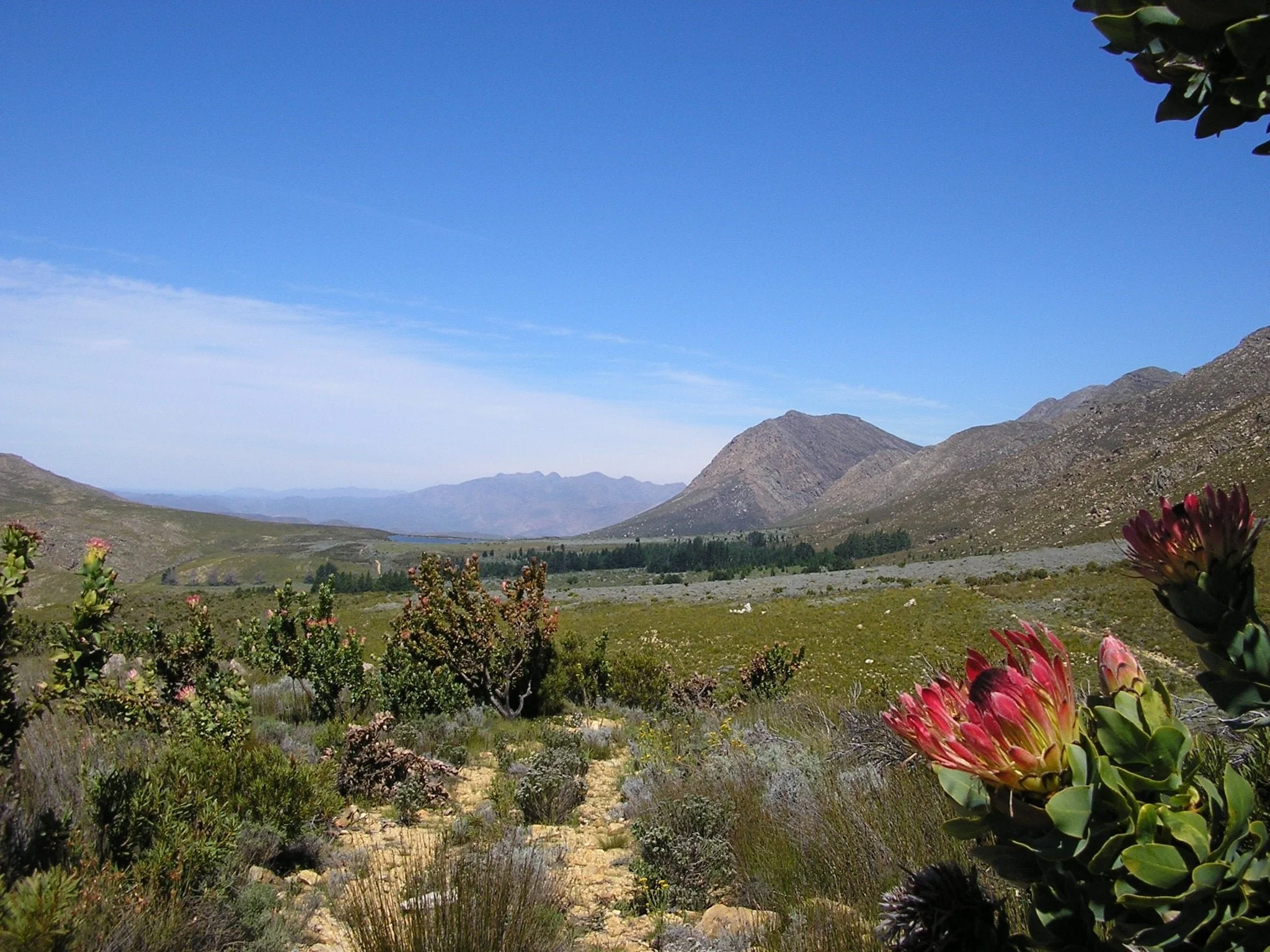
Fynbos of the Piketberg Mountains and Banghoek.
Fynbos Country
Orion Cottage sits in one of the last relatively untouched stretches of fynbos on the West Coast. Banghoek has been a registered private nature reserve since 1991. Its mountain slopes are covered in proteas, heaths and reed-like restios, with some species found here and almost nowhere else on earth.
The smallest, richest plant kingdom
The Cape Floral Kingdom is one of only six plant kingdoms in the world, and by far the smallest. It’s also one of the richest. Roughly 8,500 plant species grow in fynbos, and around 6,000 of them grow nowhere else. Fynbos packs more species into each square metre than any other plant community on the planet, more even than the richest corners of the Amazon. For comparison, the whole of the British Isles has about 1,400 plant species, and fewer than 20 of them are endemic.
Fynbos by the numbers
About 8,500 plant species, roughly 6,000 of them endemic
526 of the world’s 740 Erica species, compared with just one in the UK (heather)
96 of the world’s 160 Gladiolus species
69 of the 112 known species in the protea family
More than 1,400 plants listed as rare or threatened, and about 29 believed extinct
Some species occur in an area of one square kilometre or less
Proteas of the Piketberg
Banghoek’s Proteaceae were surveyed in 1996 by the Protea Atlas Project from Kirstenbosch. The Piketberg and its neighbouring mountains are home to a handful of special proteas:
Piketberg spiderhead (Serruria piketbergii): a small, rare protea that is still awaiting formal description. It grows only in the Piketberg and Olifantsrivier mountains. Unusually for spiderheads, it resprouts after fire, so it actually thrives when fires clear the larger proteas around it.
Piketberg pincushion (Leucospermum profugum): a creeping shrub found only on the southern slopes of the Piketberg, on rocky sandstone between 350 and 750 m. Its large flower heads open yellowish orange and fade to salmon pink from late September to December. It is listed as threatened.
Piketberg conebush (Leucadendron discolor): a vulnerable shrub whose male flower heads turn from bright red to sunshine yellow as the pollen ripens, which is where its name “discolor” comes from.
The reserve also holds a patch of renosterveld, a rare and heavily threatened vegetation type in the Western Cape.
When to visit
Something is in flower at Banghoek all year round, but September and October are the peak months, when the slopes come alive with colour.
Who else lives here
Fynbos supports a surprising amount of wildlife. Camera trap surveys in the Piketberg mountains have recorded 31 wild mammal species, including:
Hunters: Cape leopard, aardwolf, Cape fox, black-backed jackal, large spotted genet and striped polecat
Grazers and browsers: klipspringer, Cape grysbok, porcupine, aardvark and dassies
Birds: spotted eagle-owl, jackal buzzard and rock kestrel, as well as herons, thick-knees and kingfishers near water
Protecting it
Much of the Cape’s original fynbos has been lost to farming, development and invasive alien plants such as Port Jackson and rooikrans. Banghoek’s owners work to keep aliens out and let the fynbos regenerate naturally. Orion Cottage is designed to tread lightly on this landscape: off grid, with as small a footprint as possible.