
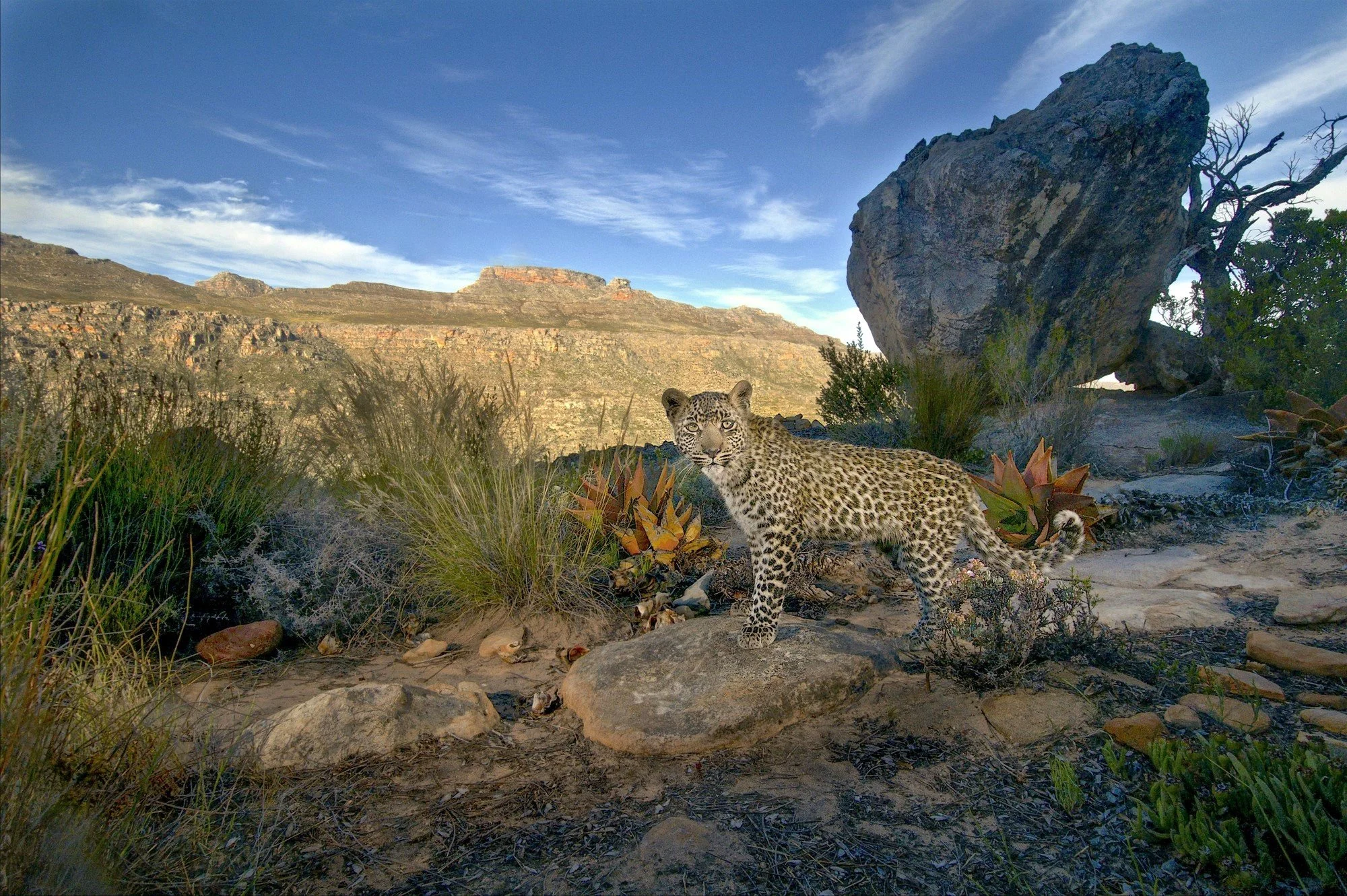
Leopards of the Piketberg Mountains and Banghoek.
Cape Leopard Country
Orion Cottage sits in the wild mountain country of the West Coast, part of the range of one of South Africa’s most elusive animals, the Cape leopard. It’s rarely seen, but its presence is everywhere: tracks on the jeep tracks, a scrape at the base of a rock, a camera trap photo taken while the valley slept.
A smaller, wilder leopard
Cape leopards are much leaner than their bushveld cousins. Males average about 35 kg and females about 20 kg, roughly half the weight of savanna leopards. With prey spread thinly across the mountains, they have to cover huge distances. A male Cape leopard can range over 200 to 1,000 km², compared with just 25 to 50 km² for a male in the Kruger National Park. Their diet is made up mostly of dassies, klipspringer, Cape grysbok and porcupine.
Piketberg by the numbers (2024/25 survey)
About 1,500 km² of mountain habitat surveyed, mostly unprotected land among farms
74 paired camera stations
154,000 images captured
Leopards recorded at 54 of 74 camera sites, a 73% detection rate
45 individual adult leopards identified
15 of them were also photographed in the 2020 survey, showing that leopards hold the same territories for years
31 wild mammal species recorded, including aardwolf, aardvark and Cape fox
Cederberg by the numbers (2023 survey)
Over 1,600 km² surveyed from June to December 2023
More than 240,000 photos
Leopards detected at 60 of 67 stations, a 90% success rate
37 different adult leopards identified
9 leopards first recorded in 2017/18 were photographed again in 2023, which researchers see as a hopeful sign of a stable population
Ten years at a glance
YearAreaWhat researchers found2017/18CederbergBaseline camera trap survey2020PiketbergFirst regional survey2023Cederberg37 adult leopards, 9 returning individuals2024/25Piketberg45 adult leopards, 15 returning individuals
Why it matters
Leopards across Africa are listed as Vulnerable, and Cape leopards face extra pressure from development and limited habitat. Snaring, poisoning, conflict with farmers, roads and large veld fires are the main threats. Most of the Piketberg leopards live on private land, so reserves and landowners play a real part in their future.
Leopard research in this region is led by the Cape Leopard Trust.